Imagination needs inspiration to bloom.


Visar inlägg med etikett Apocalypse. Visa alla inlägg

2015/12/21

The Doomsday Conspiracy by Sidney Sheldon

Commander Robert Bellamy is hired by the NSA to locate people that have witnessed a weather balloon, with some secret equipment, crash in the Swiss alps. They don't tell him why, and he soon realizes there is something big going on. It’s an interesting story and has much potential. Unfortunately, the big mystery culminates in a chase. Bellamy’s mission is to find the witnesses, but I would be more interested in the big discovery in the mountains if I were him. Bellamy’s search for the witnesses feels repetitive. They all resemble each other. Not one of them seem to care very much about the big discovery. Why have they not already contacted the newspapers? 

The book resembles the structure of a movie script, with not much inner dialogue, and it seems that Sheldon has not given a thought about how best to reveal the big mystery. Events are often presented like scenes in a movie, and it works for most of the time, but it would have been much more interesting if Sheldon valued the emotional aspect more. This is common in the genre, but I still miss the psychology, why people do as they do, and why Bellamy doesn’t question certain events. As a movie, it would have been approximately 90 minutes long, and Bellamy wouldn’t have seem that ignorant. In a book, you wonder when he will discover the truth. Bellamy is supposed to be one of the most successful naval officers. Yet, he rarely think about the cause of his mission and the whole picture.

The part where Bellamy becomes the target is interesting. He is extremely professional, and that is why he sometimes becomes disappointing. When creating falce traces, why rent a hotel room in your real name? A good agent wouldn’t do that. When trying to find a way out, why tell people where you are going? Sometimes, he is very intelligent, and sometimes not. Of course, showing the reader all perspectives right away might diminish my patience. If Sheldon had left me in the dark for a while longer, Bellamy would have seem more intelligent. Furthermore, it would have been interesting to discover everything at the same time as him.

Never the less, government cover-ups and conspiracies are always interesting, and the message of the book is very relevant and a topic of current interest. Even though the book has flaws, it's entertaining.

2015/12/18

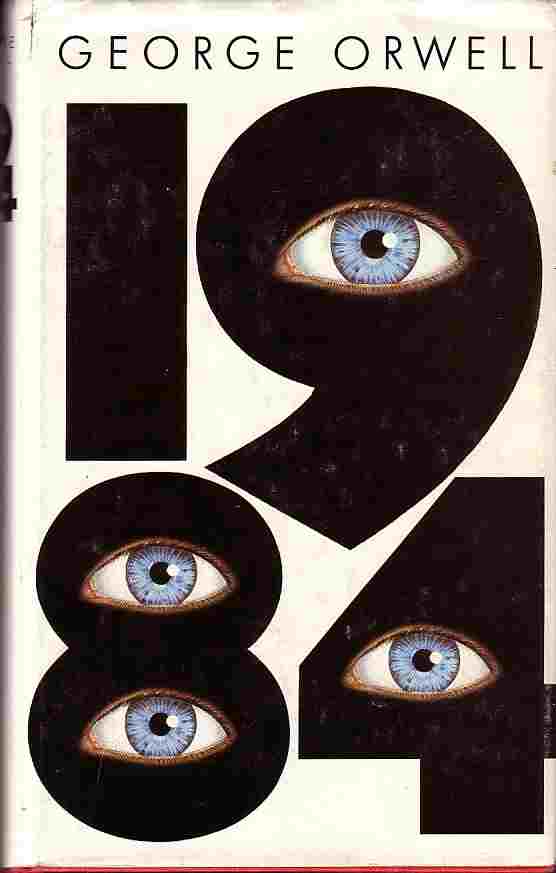
1984 by George Orwell

George Orwell’s prophecy concerning the development of society is both frightening and thought provoking. In his dystopian novel, Orwell, or Eric Arthur Blair as his real name was, predicted how the world in 1984 would be like. The book was published in 1949, in the aftermath of world war two, and has a lot of influence from the communists and nazi rule at the time.

There are themes like big brother, relativism, surveillance, collectivism, freedom, reality, manipulation, indoctrination and the biggest threat of all, love. The communist idea that the individual is replaceable, a casualty, while the system is important, is a big theme. At the same time, the system rests on the people, and therefor it is important to control them. There is no freedom of speech or even thought. The thought police arrests everyone that protest against the truth. The massive surveillance controls the people. Even though Orwell doesn’t take it as far as Karin Boye’s Kallocain, with the truth serum with the same name, he lets the thought police be able to read face expressions and tones of voice. The least deviant gets arrested and probably killed.

According to Orwell, there are four ways to bring down a totalitarian state, and in most cases it is a flaw in the system itself, or the powerful people behind it, to make it possible to overthrow. This is where this book becomes not only frightening, but disturbing. Orwell shows us that it is possible to control an entire population, and diminish the risk of being destroyed. He has thought of everything, using the mistakes of earlier dictatorships, forming a flawless oligarchy. The main character, Winston Smith, a member of the Outer party, works for the Ministry of Truth, where history is rewritten all the time, which causes a great confusion and loss of orientation, preventing people from learning, getting inspired of other people, and making comparison with other believes impossible. If all information is constantly changed, and there is no way of confirming one's memory, what is the truth, then? If you are the only source, can you be sure the information is correct? Can you trust your own mind, your memory?

Another factor for a strong oligarchy is the power of language. How words make thoughts possible. In Oceania, the political party is restricting the language through a new way of speech, without words like freedom and democracy. A restricted language means unthinking, unintelligent individuals.

The scariest part of the book is the control from within. There can be no love besides the love for Big Brother, hence the sexualpuritarism. The system is above the individual, and relationships between people are unnecessary, even a liability. The children being the worst spies reminds me of the witch hunt in the 18th century. Children don't understand the seriousness of their deeds. For them, it's just a game, and they are rewarded for it. They never learn to love their parents as their parents love them. Therefor, they don’t mind reporting them to the authorities. This totalitarian ideology depends on children scaring people and helping the system, never trusting the population. The children are brought up to be hooligans, and are justified by the ideology. The part of justifying a certain behaviour that is not humane is not totally uncommon today, when governments justify wars. The simple idea that there are two sides and the other one is always wrong is a way of uniting people. When returning from a war, soldiers are treated like heroes, despite the damage they have caused. 
Oceania constantly changes enemy. Just as in the fictional world, the winner writes history, which is a kind of censure function, and yesterday's hero might end up tomorrow's enemy. In that way, it is relevant today. It emphasizes general structures and values to an extent where they become visible and easy to question.

The proles, the ordinary, poor people that don’t belong to the political party, are not so different from us. They are easy to manipulate and not in need of indoctrination. They live simple lives with hard work, family life, sports, beer, gambling and fighting with neighbours. In what way do they differ from us? Are we not easy to control because we are busy working and consuming products that are advertised, seldom evolving into more spiritual, philosophical individuals that might discover and question flaws in the society? According to Orwell, the people that knows what really happens are the ones who are least able to see the world as it really is. The people who have information are unable to face it. The more insight, the more delusion. The powerful people in the book that know the situation, and that Oceania will never win or loose the war, are the ones who believe it the most. I wonder whether that is true for the real world, as well.

The totalitarian machine does not just oppress people. It makes them oppress themselves. Through the terms dubblethink and thoughtcrime, people repress their memories and force certain opinions.

Orwell wasn't right in his prediction about a totalitarian society taking place in 1984, not in the western world, but he was right in some cases. The dystopian novel is very disturbing to read, because in a way, the book is more relevant today than ever. We are being watched, our telephone calls are being monitored, and we leave fingerprints everywhere on the internet. Is it possible to be free? What is freedom?

2015/01/13

The walking dead, volume 1 by Robert Kirkman

The police officer Rick wakes up in a hospital and discovers the world has changed. Zombie creatures are everywhere and mankind is forced to hide or kill them. The society has collapsed, and small groups of people are trying to survive.

I don't have much experience in graphic novels, but this is my point of view. This is a novel about a zombie apocalypse, but it's also so much more. In the introduction, Robert Kirkman explains that he was interesting in portraying a different zombie story. The psychological aspect was important, which is evident in the main character's change through the story, in a time that demands great, and not always kind, measures. That is one of the most interesting themes in the book. The story is not first and foremost a story about the apocalypse, but a story with psychological dimensions.

As for the layout, the book is well-detailed and carefully crafted. The pictures are really artful, with everything from the shadows to the characters face expressions.

However, there are some minor distracting details, from a gender perspective. The division of responsibilities in the group is interesting. Everyone should benefit from learning all kind of skills. That is necessary since no one knows what the future holds. Donna mentions that the women clean the clothes because of their gender, and she is onto something. Unfortunately, she is portrayed as a whiny, bitter woman and Lori - who doesn't question anything, and equals the proper woman - is protesting against Donna. Upholding gender differences don't belong in this kind of situation. Of course, the most skilled should do the work. Man or woman. Rick should be hunting. He is a police officer, accustomed to danger and weapons. But Andrea turns out to be a rather good shot, as well. Why make a big thing about it? Women can be heroes, as well.

Another thing worth mentioning is the quote that Dale "deserves" two women - of course young and beautiful - living with him, indicating something, but Dale merely states that they are only friends. Why not let them do whatever they want together, and neither honor or condemn it? Perhaps some indulgence is necessary, but what is the meaning of portraying women's purpose as being a reward for men that "deserve" it, without consideration to the women's needs? Why is it never the opposite, that a women deserves two young, beautiful men? I don't think the characters have these remarks in the tv-series, so I'm biased since I watched it before I read it.

When it comes to the structure of the characters in the book, the obvious leader, Rick, is a good man, most of the time, but the fact that he appoints himself as the leader of the group, only questioned by Shane, is another silent rule. Kirkman had a possibility to explore gender equality, but he passed. It's evident the book is written for men. However, the most irritating character is Lori. Why is she so boring and unlikable? She and Shane knew where Rick was and thought he was safe, but even so, didn't come back for him. When Rick woke up, he was crazy about finding his family. Why couldn't Lori be the same?

The most interesting theme in the book is about humanity and responsibility in this kind of situation. To what extent are we supposed to take care of each other? How human are we? In many ways, mankind is worse than the walking dead because people are responsible for their actions. The book is as much a social commentary as a zombie apocalypse story. It's fascinating to enter a world where the normal laws don't apply anymore. This is the first book, and just the beginning, but Rick's gradual change in the series is a way of showing how much our ordinary lives are driven by laws, social structures. It's easy to follow the laws and be humble and empathetic when everything is normal. But when the society has collapsed, some other, more primitive, factors about survival instinct surface and become significant.

2014/06/02

The Stand by Stephen King

When a plague strikes, the few people left begin having dreams about two different people that are each other's nemesis. They can choose to be a part of an old woman's fellowship, or to join the dark side, a totalitarianism. In the beginning the chapters alternate between different characters such as the pregnant Frannie, the musician Larry, the deaf-mute Nick, the slightly introverted Harold, the imprisoned Stu, the intellectually challenged Tom, the intellectual Glen, the mysterious Nadine, the criminal Lloyd, and last but not least, the dog Kojak. They are flawed and absolutely no saints before the plague – a brilliant concept. Thus, they are no given leaders. But, all of a sudden, they get a second chance to take responsibility, and save themselves from destruction. Some of them does, despite moments of hesitation. Others don't. There's no foreseeing who will be sympathetic and not, who will take the opportunity to face their past and who will exploit the change to power. They all get a second chance. Stephen King is cleverly describing the core of a person's true identity. When the filter of materialism and comfort are gone, as well as the lack of structure, rules and laws, it's easier to unfold people's inner nature. Suddenly, their true identity emerges. The existence of, or lack there of, sympathy and empathy become very clear.

The story about a group of people's current construction of a new society gives birth to some interesting questions. The question of democracy. Is it the opinion of the majority of the people or the decision that is best for them? The question about whether people are born with morals or something that they possibly incorporate later on. The question about good and evil, and whether people are really aware of the difference - is there a difference? Can we choose who we are, or are we incorrigible? What's fascinating about the evil Flagg is that he is powerless without people's fear and lynch behavior. He feeds on it. Evil can take many shapes, but is only as powerful as people's minds permit.

It's interesting to consider the normal society we're used to from a stranger's perspective. After living a free life for a while, how would we perceive the traditional structure and rules of society? The characters speculate about what kind of society they want to build and if they are going to change something from the old one. What if there are other ways to run a society? Without materialism there wouldn't be the same kind of differences between people. The struggle between the traditional laws and individual freedom becomes distinct during the new organisation of society structure, and the potential danger of organisation and power is reflected upon. This makes the reader speculate about how close we really are to become our own destruction.

The unabridged version of 1200-pages offer a profound description of the main characters, something that feels tedious at times, but might be healthy for the reader to be able comprehend the amplitude of the story. The book contains different themes such as speculative realism, science fiction, fantasy and religious symbolism. Perhaps the story would have benefited from simply one of them - speculative realism. The reader might choose which perspective to view it from, but it's not really necessary to throw in fantasy and supernatural elements. The reader might even have difficulties to interpret certain parts. What really caused the catastrophy that threw the world into a dystopian setting? Mankind or God?

The book, more than anything else, leaves the reader with one question. Are we able to learn from our mistakes? Stephen King seems to have faith in us, but we are easily tempted. This is one of his most famous works, perhaps because it's subtle and layered and contains many different sub themes, where people's inner nature and the contrast between the right choice and the easy choice are very distinguished.

2014/02/07

The 5th wave by Rick Yancey

Cassie lives in a tent in the forest. She is alone and every person she meets are a potential threat. Since the apocalypse, there's no telling who is human and who is one of "the others". After being alone for a long while, she meets Evan Walker, and even though she has promised herself to trust no one, she craves the company of another person.

Unfortunately, the surprises in the book were rather predictable and it was a long time of waiting for the characters to catch up. Then, it finally got interesting. However, the main character Cassie came off as a little flat. At first, she seems to be a really strong type, but when she needs to keep her head clear the most, in the middle of a life threatening situation, or in a situation where something really bad has happened and she should be lucky to be alive, she thinks such strange and completely inappropriate thoughts. Her vain and shallow moments with these irritating clichés popping up in her head, might indicate that it's sometimes difficult for a male author to write a believable female character properly. It's much easier to understand Evan Walker and Ben Parish, but Cassie's constant nagging about irrelevant details about her looks or anyone else's, is irritating and might diminish some readers' sympathy for her. It doesn't matter that she is very young. Young doesn't mean stupid. "The Hunger Games"' star Katniss Everdeen proves that. But, after a while, Cassie is more convincing and perhaps the reason she was a little stupid can be explained by the long time of loneliness, and that Evan became her whole world.

In the whole, as usual, the apocalyptic concept is interesting, but not at all in the same league as apocalyptic novels, such as Cormac McCarthy's "The Road", or H. G. Wells' "The War of the Worlds". This being a young adult novel, a comparison is rather unfair, but it's almost equally far from "The Hunger Games". But, anyway, it's entertaining in an eventful kind of way, and fit into the sometimes cliché world of the young adult category.

2014/01/18

The War of the Worlds by H. G. Wells

The novel is one of five in the H. G. Wells "Classic Collection". "The War of the Worlds" was first published in book form in 1898, and is one of the first books containing a meeting with extra terrestrials. Wells was before his time with his reasoning science tone throughout the book. He has thought of everything, nothing is ignored. His knowledge about science is fascinating.

A shooting star turns out to be something totally different and the beginning of a war the human race could never have imagined, let alone anticipated. When a cylinder crasch into the earth, it doesn't take a long time for a war to begin. In the middle of this, a man and his brother, in separated ways, struggle to survive. Not government officials or a police officers. Simple men.

The only flaw is the lack of character descriptions. The reader doesn't even get to know the names of the main characters, referred to only as ”I”, in the first person narrative, and ”my brother” in the second. But, on the other hand, like in the novel "The Road", the focus lies elsewhere - In this case, it concentrates on a society encountering something so incredible, so unpredictable, that the human race is totally unprepared of it, and what happens in such a devastating situation.

The purpose of the book might have been to explore the themes of relativity and evolution. Relativity, as to the question of morality, and good an evil. Wells discusses the possibility of an attack from a planet, Mars, that becomes uninhabitable and thus forces its beings to seek another place for settlement. They are just in a dire situation for their survival. The Martians aren't trying to kill people for the sake of it. They focus on destroying the organization, the infrastructure and other foundations of society, to eventually be able to make their own, without being disturbed. Then, human beings can serve as nourishment. The Martians aren't unlike human beings in the way that they take what they want, regardless of their absence of rights.

Evolution, as to the survival of the fittest, the development of the Martians, and the question if humans will evolve into a big brain, without bodily organs, digestive systems and sexual reproduction - which in the long term perhaps would diminish the human emotions and mental characteristics. What would happen then? What will happen if we're still around when the sun has cooled and we are forced to explore the universe for survival? In this way, "The War of the Worlds" awakes thoughtful, existential questions. Will we be humble, merciful and considerate to the inferior races on other planets, if they turn out to be inferior, or will we just repeat the cruel actions to native americans, black people, and the pursuit of jews and other minorities, still going on today? Do the people of the Earth have the rights to decide who are inferior and who are superior? Do we have the right to exploit whatever we want?