Imagination needs inspiration to bloom.


Visar inlägg med etikett Play. Visa alla inlägg

2015/12/02

The Chairs by Eugène Ionesco

The play, written by Eugène Ionesco, consists of an Old Man and an Old Woman, moving around many chairs. It's one of the plays that became the foundation for a theatrical movement called Théâtre de l'Absurde.

There are only two people in the play, except the orator that make an entrance later. The other characters are invisible. Perhaps the Old Man och Old Women are the only ones left in the world. Perhaps an apocalypse has destroyed the earth, leaving nothing behind. They say that there is no Paris anymore, and talk about an old memory repeatedly. The chairs might symbolise their long lost friends. Another explanation is that the imaginary guests are real people, but with an absent mind. They are there, but at the same time not. However, despite being invisible, they seem more alive than the strange orator, who seems more like a robot than a human being. Are they in the future?

There are many themes in the play. The need to be remembered is easy to identify with. No one wants to be forgotten forever. When finding the meaning of life, or whatever discovery the Old Man has made, will garantee it. Perhaps the chairs symbolise the importance to not forget people. Or perhaps the couple might have dementia? Or being prisoners, bored and wanting to entertain themselves? It doesn't really matter. The play is about memories, and the ability to remember a past that was better than the present. It is about regret. The Old Woman often tells her husband what he could have become if he only were more ambitious. Now, when he has the answer to everything, and will reveal the secret to the world, he will finally be someone. He will be remembered.

The reason that the orator doesn't succeed to reveal the Old Man's discovery is perhaps because of the Old Man. He doesn't dare to reveal his discovery himself. Instead he escapes. If not believing in oneself, no one else does. He seems to have escaped many things in his life. He denies having a son and he admits having abandoned his dying mother. Is the empty room a form of escapism? The lack of responsibility is a great theme. By the way, perhaps the orator really tells the audience the meaning of life. They are just unable to understand it, because it's impossible to understand.

What's good about this play is that it makes you think. There are many interpretations possible, and the story surely means different things to different people.

2015/11/26

Romeo and Juliet by William Shakespeare

Being one of the most famous plays through all time, Romeo and Juliet still captivates readers and audiences around the world. This is a fine example of the fact that time doesn't really have to change us. We can still understand and identify with great stories from a long time ago. Romeo and Juliet is a play that centers around forbiddem love between two young, rebellious people. But the play is much more than that.

There are some parts that would need some explaining. The reason for the long lasting war between the families is never explained. Perhaps it's not important, but it would be interesting to know what caused this hate. Another detail is the age of the star-crossed lovers. They are so young. Is it possible to know and understand love at that age? Especially when just having met the person? Romeo seems to have been as romantically absorbed just some days earlier, and he got over Rosaline fast. Could it, in fact, be more about sexual attraction than real love? Or is that to destroy on of the most romantuc plays of all time? Just some thoughts.

Never the less, it is a strong play with so much emotion and a wonderfully written. It alternates between different forms, some of it rhyme. Those parts are really beautiful. Although, I think some of the beauty gets lost in the translation of such a work. This is a new Swedish translation, and some words just seem misplaced. Even though the prose evolves and changes through time, it still has to fit into a 16th century enivronment.

Everything happens so fast, which is rather common for plays. Deciding to kill, die or love takes a fraction of a second. Why not think everything through for a while? It would have been nice with more of the inner dialogues to follow the characters thoughts leading to their decision. I have not seen the play on stage, perhaps it's different.

This play is about so much more than unconditional love. It is about a difficult world with tough love. It is about parents that choose their daughter's future, and it is about refusing to live one's life on others' terms. Most of all, it is, although tragically and at a very high price, about choosing independence. This play comes alive and really moves and affecte its readers. Perhaps because it is easy to understand the young couple's difficulty that drives them out of this world. It tells us much about women as properties and merchandise, and the consequences when ignoring their opinions and needs. In one way, it is still relevant. Many parents still have their children's future decided even before they really know them. Perhaps it is to take over the family business, going to college or marry someone from the same country or religion. Romeo and Juliet defy their destinies, and take power over them.

A commentary chapter contains a discussion by the translator about underlying themes and structures of the book, including the balance between the families, this rivalty about power. The peace of Verona rests upon this symmetry - almost like a stalement - where none of the families can win. A marriage between Juliet, a Capulet, and Paris, a relative of the emperor, would brake the power balance between the Capulets and the Montagues. Romeo's and Juliet's love, born from hate between their families, is what finally restore peace in Verona. That is what is tragic and beautiful. Two young people are sacrificed on the altar of peace.

2015/01/03

Arcadia by Tom Stoppard

Philosophy vs science progress. What is more important to mankind? What makes us happy? The play Arcadia (1993) is set in a country house, Sidley Park, in Derbyshire, and follows the lives of people living there in the 1800's and present day.

The play is rich and complex. Stoppard explores many different themes and contrasts such as past and present, and order and disorder. They melt together and show that everything is connected. The story offers more questions than answers. It involves philosophy, history, classic literature, mystical poets like Lord Byron, landscape design, murder speculations, population dynamics, mathematical algorithms and thermodynamics. And everything comes together perfectly. Some of the characters even investigate science that challenges Newton's theories of physics. It's very interesting for people with great curiousity. 

The play also investigates the meaning of certainty, the nature of evidence and truth in modern ideas about history, mathematics and physics. Clues from the past can be interpreted in different ways. And because they can't be proven to be false, does that mean they are true? Is truth the necessary opposite of false? The characters are struggling with this problem when they are thinking about history and time. Much of the play centers around time - research about history and attempts of predicting the future with an equation, and the exceptions that make it impossible. They discuss the hypothetical theory about the prediction of the future being prevented by irregularities such as sex. Perhaps love is the exception of the rule, which makes the future so difficult to predict. The disorder in feelings, the contrast, or perhaps the connection, of passion and madness, is a kind of practical example of chaos theory. The concept of order vs chaos theory is explored in different ways, both in personal feelings and physical disorder (the table in the center of the room that collects objects from both time periods). The characters' social order moves into chaos, where time is depicted as a kind of illusion. However, there might be order in chaos, perhaps we are incapable of perceiving it because our lack of knowledge.

There's a tragic theme of smallness, universal insufficiency and the life going in one direction. Despite Newton's equations that goes both ways, there are certain events that are irreversible, like time, and fire and heat (the second law of thermodynamics), as well as the cooling universe and burned relationships. But the characters in the 1800's are living on in descendants and letters. Life is eternal, and at the same time, it is the exception of the rule. Stoppard paints this picture splendidly. When there's chaos, there are no longer any rules, and the different eras intermingle. The structure of the play is a work of art itself.

Last but not least, every theme is evolving from the source of love and death and it's both tragic, comical and thrilling. And regardless of time they think and reflect. This is a play for people not wanting to be served answers, but prefer to interpret and form their opinions along the way. Answers are not important. Conversation is. So, connecting the dots, philosophy or science progress, reflection or knowledge? When the characters face a dark future, and when the world is doomed – due to chaos theory - they turn to music and waltz. So, perhaps that is one answer to the question about what's more important to mankind?

2014/02/23

Skådespelerskan by Anne Charlotte Leffler

When Helge Stålberg presents his future wife, Ester Larsson, to his family, she is doomed from the beginning. She is out-spoken and coquettish, immediately drawing attention to herself. And, worse, she's an actress. She wants to fit into the family badly, and is prepared to perform, but her role as the ”woman” she thinks Helge wants her to be, fails considerably, and the real Ester shines through. 

The play was published in 1873, in a time when women were considered suitable for household duties and not public inspection. While Ester preformed, and was seen and admired by the audience, middle-class women hardly went ouside their homes without an escort, in that way avoiding to be viewed as every man's property. Ester wasn't modest and pleasant, she was the center of attention and thereby trespassing the boundaries of female conventions. She became the topic of conversation, and the men's amusement and object of admiration, something that aggravated the women in the family, who was suddenly forced to consider their own feminity and sexuality. The theme is the middle-class woman, used to supress her desires, meeting with the actress, used to play upon her sexuality and men's weekness for it. They are both, in different ways, identities produced by the norms and conventions of society, that still exists today.

The play was controversial for its time, considering the main theme of female identity, imprisonment and inferiority, as well as the married woman's silent war for independence. In many ways it resembles authors like Strindberg and Ibsen, when it comes to Leffler's direct approached and the topic of freedom from prejudice.

There's an interesting parallel between the author and her main character, Ester Larsson. Leffler's husband wasn't pleased with her writing ambitions, which didn't fit into the womanly qualitites, and she wrote in secret, under a pseudonym. Eventually, her plays were successful, and she began to write under her own name, despite her husband's objections. Leffler divorced him, moved to Italy and married a ten years younger man, who was her equal and colleague, encouraging her in the same way as her parents had done. Finally, as strongly as her character Ester Larsson, she had freed herself from the conventions of society. Furthermore, her plays became some of the most performed in the nordic countries in the 1880's.

2014/01/10

A Doll's House by Henrik Ibsen

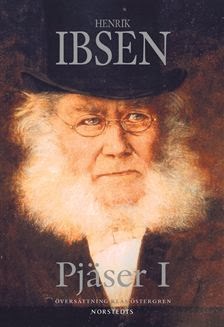
"A Doll's House", "Ett dockhem" in Swedish, is one of the plays included in "Pjäser 1". Being one of the most talented playwrights in the 19th century, Henrik Ibsen, the Norwegian counterpart to Swedish Strindberg, is the most frequent performed dramatist in the world, second to Shakespeare. It's impossible to describe how influential he was. Ibsen is referred to as "the father of realism". "A Doll's House", premiered in 1879 a few weeks after its publication, became the most performed play in the world. UNESCO has inscribed the autographed manuscripts on the "Memory of the world register" because of it's historical value.

The main theme in the play is women rights in a society of neglect and ignorance, where the only accepted roles for a woman to play were wife and mother. The title is referred to the main theme, comparing women to diminished, helpless and frivolous dolls, in the need of a husband to protect and provide for them. On the surface, the marriage seems happy if seen through the eyes of the 19th century people. The character Nora pretends to be someone she is not. Eventually, though, she refuses to succumb to the conventions of society.  It's a strong play with a strong female character, a feminist of her time.