Imagination needs inspiration to bloom.


2016/01/28

War's unwomanly face by Svetlana Alexievich

Svetlana Alexievich has interviewed countless people during many years, to describe the soul of the Soviet Union, in her series "Voices from the Big Utopia". She received the Nobel price in literature in 2015. In this book, two hundred women speaks of the time during the war. How they fought the enemy, how they rescued wounded soldiers, and how they themselves fired sniper’s rifle, bombed and killed. They had learned to hate, but even during the darkest of times, their hearts loved, and they saved not only their own, but German soldiers as well. Svetlana Alexievich collects these stories and makes art.

This book really affected me. It feels like I have been there, at the front, among the soldiers. 
Together, they make a choir of voices, and I wonder whether it’s easier to understand the reality of that time from one single person’s testimony, or through the fabric of many memories. The book is full of strong voices that have been silent for forty years. It was time the emotional shards, the human destinies, were told.

This is not a hero book. This book is not focusing on the winning of the war, but on the reality during and after the war. The women's stories are colorful. They remembered feelings and details, and they never stopped appreciating beauty and art. Some refused to change from their dresses, others slept with their earrings, while yet others slept while sitting up to be able to wear hats as long as possible. Because, in daytime, everything that was considered female was forbidden.

Surprisingly many young women volunteered to fight at the front. At a very young age, they convinced their parents to be allowed to participate, or escaped from their homes to join the army and be sent to the front. The loyalty to their country was immense, and more important than their families. It was not only the young girls dreams. Some of the parents even wanted their young daughters to join the army. It's difficult to understand their enormous devotion. Their team spirit and companionship. It's a big difference between communism and today's individualism, and it's interesting to learn about a totally different perspective of live.

One might think that women’s part of the war indicates some gender equality, but even though women were allowed to join the army, the men treated them far from equal, and used all kinds of excuses to justify their behavior. Their view of these women became very clear after the war, when many of them didn't want to marry a woman soldier, and even despised them. Half a million women sacrificed everything, and when returning from the war, they were forgotten. And while the male soldiers were received as heroes, the female soldiers were viewed as unfeminine and unattractive. I want to remember everyone. It’s difficult to explain, but I feel like I owe them that. They have been alone with their feelings for a very long time, abandoned by the society after the war. The least I can do is to listen to them, and remember them. She who made herself a white dress of a German parachute and married her love before a battle. She who let her daughter carry a bomb. She who drowned her own baby to not be found by the German soldiers. She who kissed her husband for the very last time. She who gave the enemy bread. She who was captured and tortured. She who still can’t handle the color red. She who came home and realized her child didn’t recognize her. She who returned home and found her own grave. And many more.

They all deserve to be remembered. This book makes them as invincible and immortal as they once were.

2016/01/13

The Lover by Marguerite Duras

The book takes place in the French Indochina. A young, French girl in the colonial class falls in love with a rich, Chinese man and it is the beginning of a romance, despite her mother’s fear of her destroying her chances to be married.

The story technique differ from many other novels with biographical elements. It is not written in chronological order, but takes leaps in time. The novel is consisting of many short sentences, mixed with longer ones.

It’s a dense book. The prose is spare and often objective, something that is appreciated by some, and not by others. It is difficult to really know the characters when not getting into their heads. The book is beautifully written, but leaves much for the reader to comprehend and read between the lines. Indochina was a part of the French Colonial Empire, and the girl and the man can be interpreted as symbols of power and the occupied. It’s an interesting book that takes time to digest.

2016/01/04

Night Film by Marisha Pessl

When Ashley, the daughter of a famous movie director, Stanislas Cordova, is found dead, the journalist Scott McGrath begins to investigate the family. Last time he worked on a case about the family ended in a personal tragedy. This time, something even more important might be on the line.

It took a while to get into the book. Scott McGrath was a clean slate and not very interesting, except his obsession with Cordova. I didn’t think Ashley Cordova was especially fascinating either, despite the author’s attempt. For a long time seemed like a confused emo teenager. The only character that I found interesting right away was Nora.

Just as in Cordova’s movies, there are unexplained elements and soon, Scott’s entire life is almost turning into one of these movies. Is it a dream? Is he going mad? It’s difficult to know where reality ends and illusion begins. Perhaps that is what makes this book special. Magical cracks is cutting through the world and make him question the reality and himself. Cordova’s movies seem to have a story technique that is a mixture of Alfred Hitchcock and Ingmar Bergman, but more frightening and controversial. Such movies are being interpreted and often considered cult. There are more similarities, as well. Just as Cordova, Bergman filmed many movies on his estate on Fårö in Sweden.

The author uses a special grip. She fills the novel with fake photographies and articles to frame the story and put the reader into the world of the book. It’s an interesting concept, and works most of the time, but the those supposed to be photographs of Ashley look staged. She looks more like an angry model than a mysterious, fascinating pianist.

Something happens two thirds into the book. Suddenly, the pace is increasing, and the book becomes intense when the story begins to unfold. It’s a unusual book in many ways, not least when it comes to the gothic feeling that rests over the family Cordova, that soon envelops the main character.

2016/01/03

Jag lever, pappa: Utöya, 22 juli 2011 - Dagen som förändrade oss

The book describes the terrorist attack, 2011, in Oslo from two perspectives. Siri, a 20-year old girl, was at a Labour party summer camp on the island Utöya when the massacre occurred that killed 69 people. She called her father, Erik, a former journalist, when running for her life. Erik tries to understand what is happening.

First, the government quarter were bombed, killing several people. Two hours later, people on Utöya began to hear gun shots, ran and tried to hide. When a man, dressed like a police officer, arrived, people were relaxing, never imagining that the man was in fact the terrorist, Anders Behring Breivik. He shot everyone he could find, except small children. Siri found a way down the cliff to the shore, and hid with several others in a small cave that barely covered them. At the same time, her father tried to understand what was going on, and when he realized that someone was killing people, he drove out to the nearest point on mainland, feeling afraid and powerless.

How do you handle life after terror? How do you manage everything? Do you change? If you do, then how? The book gives insight to the massacre and how the people that survived were marked deep for ever, struggled to carry on, mourned the dead and remembered the attack, but refused to let themselves be defined by it. After the terror, Siri was very tense and reacted on every sound around her. She thought it uncomfortable to be around police officers. At the same time, she was strong and very determined to not let the fear win. In this way, the book is offering a deeper insight, a reflexion of what such a experience do to people, and how they are feeling weeks later when everyone else is carrying on.

The book might have been shorter. It is about hundred pages of memorials and other gatherings, and they are all very similar. They are important, of course, but it feels like the book drags on. It is not written in the best of ways, the language is a little uneven and sometimes repetitive. First, we get to read about Siri’s experiences, and then we get to reread the same situation from Erik’s point of view. During the terror, it’s effective because it’s interesting to get to know as much as possible of the time. But after the attack, occasionally, it slows down the pace.

However, it's an important portrayal of the worst attack in Norway in modern time. In all, 77 people were killed in the two attacks. Both Siri and Erik realized the importance of reporting, and through this book, they contribute to the event not ever being forgotten.

2015/12/26

Omgiven av idioter: Hur man förstår dem som inte går att förstå by Thomas Erikson

Have you wondered why you sometimes need to be alone for a while with your thoughts? Or why you always have to be the center of attention? Why certain people are so careless and sloppy? Or why you are surrounded by idiots? Thomas Erikson is explaining all this. He uses a known method to sort differences in communication and categorize people into four different groups, or personality types. Red people are impatient and focused on results, yellow people are positive and need to be the center of attention, green people, which are the most common, are calm and good listeners, and blue people are well organized and pay attention to detail. Everyone is needed and the best group is consisting of all colors. 

People critical to this would certainly claim that it’s difficult to categorize people, but, of course, this method includes numerous variations, and most people have more than one color. Another critical comment might be that dividing people into groups is something that should be prevented, but Thomas Erikson doesn't value one quality more than another, he just states that we are all different. This is just a way to understand each other. We get to know the cause of conflicts and how best to treat them. Of course, this is not a totally waterproof method. People are unpredictable and complicated. The reality is always more complex.

The book, a new edition, is entertaining and useful, both at work and in private life. Everyone benefits from this because everyone we all use communication.

2015/12/21

The Doomsday Conspiracy by Sidney Sheldon

Commander Robert Bellamy is hired by the NSA to locate people that have witnessed a weather balloon, with some secret equipment, crash in the Swiss alps. They don't tell him why, and he soon realizes there is something big going on. It’s an interesting story and has much potential. Unfortunately, the big mystery culminates in a chase. Bellamy’s mission is to find the witnesses, but I would be more interested in the big discovery in the mountains if I were him. Bellamy’s search for the witnesses feels repetitive. They all resemble each other. Not one of them seem to care very much about the big discovery. Why have they not already contacted the newspapers? 

The book resembles the structure of a movie script, with not much inner dialogue, and it seems that Sheldon has not given a thought about how best to reveal the big mystery. Events are often presented like scenes in a movie, and it works for most of the time, but it would have been much more interesting if Sheldon valued the emotional aspect more. This is common in the genre, but I still miss the psychology, why people do as they do, and why Bellamy doesn’t question certain events. As a movie, it would have been approximately 90 minutes long, and Bellamy wouldn’t have seem that ignorant. In a book, you wonder when he will discover the truth. Bellamy is supposed to be one of the most successful naval officers. Yet, he rarely think about the cause of his mission and the whole picture.

The part where Bellamy becomes the target is interesting. He is extremely professional, and that is why he sometimes becomes disappointing. When creating falce traces, why rent a hotel room in your real name? A good agent wouldn’t do that. When trying to find a way out, why tell people where you are going? Sometimes, he is very intelligent, and sometimes not. Of course, showing the reader all perspectives right away might diminish my patience. If Sheldon had left me in the dark for a while longer, Bellamy would have seem more intelligent. Furthermore, it would have been interesting to discover everything at the same time as him.

Never the less, government cover-ups and conspiracies are always interesting, and the message of the book is very relevant and a topic of current interest. Even though the book has flaws, it's entertaining.

2015/12/18

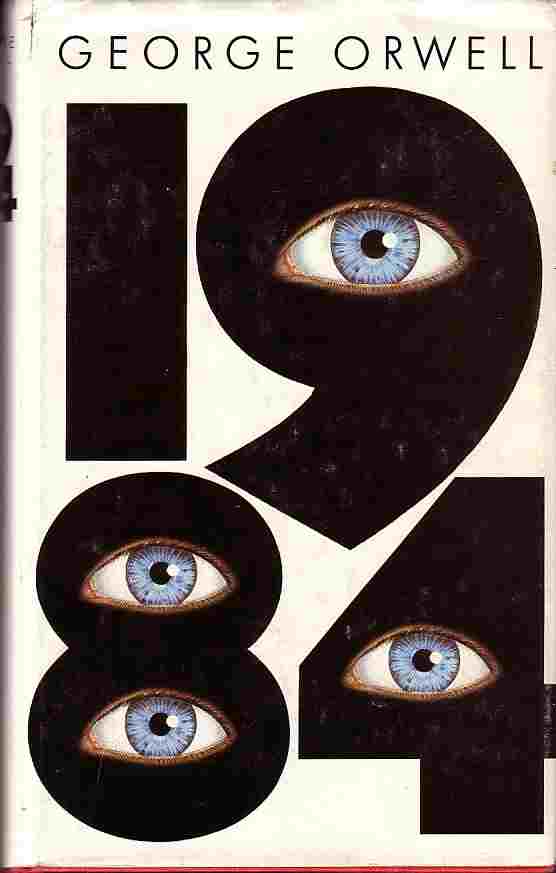
1984 by George Orwell

George Orwell’s prophecy concerning the development of society is both frightening and thought provoking. In his dystopian novel, Orwell, or Eric Arthur Blair as his real name was, predicted how the world in 1984 would be like. The book was published in 1949, in the aftermath of world war two, and has a lot of influence from the communists and nazi rule at the time.

There are themes like big brother, relativism, surveillance, collectivism, freedom, reality, manipulation, indoctrination and the biggest threat of all, love. The communist idea that the individual is replaceable, a casualty, while the system is important, is a big theme. At the same time, the system rests on the people, and therefor it is important to control them. There is no freedom of speech or even thought. The thought police arrests everyone that protest against the truth. The massive surveillance controls the people. Even though Orwell doesn’t take it as far as Karin Boye’s Kallocain, with the truth serum with the same name, he lets the thought police be able to read face expressions and tones of voice. The least deviant gets arrested and probably killed.

According to Orwell, there are four ways to bring down a totalitarian state, and in most cases it is a flaw in the system itself, or the powerful people behind it, to make it possible to overthrow. This is where this book becomes not only frightening, but disturbing. Orwell shows us that it is possible to control an entire population, and diminish the risk of being destroyed. He has thought of everything, using the mistakes of earlier dictatorships, forming a flawless oligarchy. The main character, Winston Smith, a member of the Outer party, works for the Ministry of Truth, where history is rewritten all the time, which causes a great confusion and loss of orientation, preventing people from learning, getting inspired of other people, and making comparison with other believes impossible. If all information is constantly changed, and there is no way of confirming one's memory, what is the truth, then? If you are the only source, can you be sure the information is correct? Can you trust your own mind, your memory?

Another factor for a strong oligarchy is the power of language. How words make thoughts possible. In Oceania, the political party is restricting the language through a new way of speech, without words like freedom and democracy. A restricted language means unthinking, unintelligent individuals.

The scariest part of the book is the control from within. There can be no love besides the love for Big Brother, hence the sexualpuritarism. The system is above the individual, and relationships between people are unnecessary, even a liability. The children being the worst spies reminds me of the witch hunt in the 18th century. Children don't understand the seriousness of their deeds. For them, it's just a game, and they are rewarded for it. They never learn to love their parents as their parents love them. Therefor, they don’t mind reporting them to the authorities. This totalitarian ideology depends on children scaring people and helping the system, never trusting the population. The children are brought up to be hooligans, and are justified by the ideology. The part of justifying a certain behaviour that is not humane is not totally uncommon today, when governments justify wars. The simple idea that there are two sides and the other one is always wrong is a way of uniting people. When returning from a war, soldiers are treated like heroes, despite the damage they have caused. 
Oceania constantly changes enemy. Just as in the fictional world, the winner writes history, which is a kind of censure function, and yesterday's hero might end up tomorrow's enemy. In that way, it is relevant today. It emphasizes general structures and values to an extent where they become visible and easy to question.

The proles, the ordinary, poor people that don’t belong to the political party, are not so different from us. They are easy to manipulate and not in need of indoctrination. They live simple lives with hard work, family life, sports, beer, gambling and fighting with neighbours. In what way do they differ from us? Are we not easy to control because we are busy working and consuming products that are advertised, seldom evolving into more spiritual, philosophical individuals that might discover and question flaws in the society? According to Orwell, the people that knows what really happens are the ones who are least able to see the world as it really is. The people who have information are unable to face it. The more insight, the more delusion. The powerful people in the book that know the situation, and that Oceania will never win or loose the war, are the ones who believe it the most. I wonder whether that is true for the real world, as well.

The totalitarian machine does not just oppress people. It makes them oppress themselves. Through the terms dubblethink and thoughtcrime, people repress their memories and force certain opinions.

Orwell wasn't right in his prediction about a totalitarian society taking place in 1984, not in the western world, but he was right in some cases. The dystopian novel is very disturbing to read, because in a way, the book is more relevant today than ever. We are being watched, our telephone calls are being monitored, and we leave fingerprints everywhere on the internet. Is it possible to be free? What is freedom?